by: Brahim Laaraibi
Inside a conflict fueled by a twisted script that claims the land and sacrifices its people, As She Lies Beneath the Rubble is a story about how resemblance–seen, denied, and finally faced–has turned adversaries into reflections.
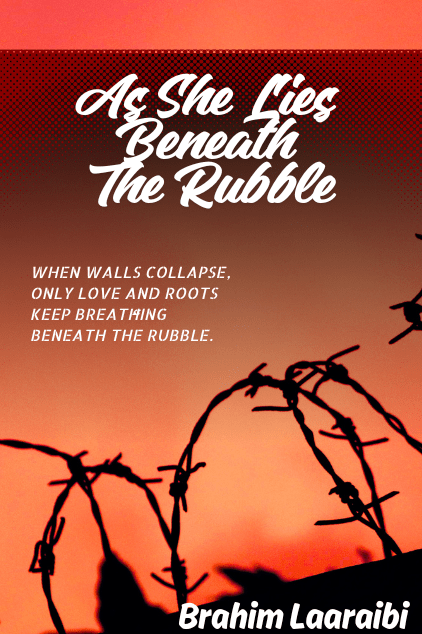
Samia lies pinned beneath a slab of concrete, the weight grinding into her ribs, squeezing every breath. Dust claws at her throat. Somewhere, a child’s cry cuts through the darkness, and she answers without words, sensing her children closer, shielding them from shards of glass.
Her mind slides towards a gentler place, memories fluttering like a lone candle in the gloom.
“I don’t know why nothing pleases you,” she’d snapped once, exhausted, her baby girl fussing at her breast, Imad’s silent frustration boiling just beyond her reach.
Back then, she could still remember dancing in the Hebron theatre, Dabke steps pounding the stage, Imad watching, stunned by the fierce hope in her movements. That was before the soldiers came, before checkpoints turned every road to a question mark.
They married, dreamed together, carried the banners of protests through crowded streets. When their daughter was born, joy lit up a room already filled with fear. A second child, a boy, arrived in the cradle of a siege.
But under the weight of daily survival, Imad grew brittle, eyes hollow, spirit restless. One morning he left for the cafe and never returned. Arrest? Resistance? Betrayal? The rumors swirled, but Samia had no answers.
Then the Israeli police came for her.
The steel door slammed behind her in the station. Cold light scraped against her eyes. Noam, the officer, sat across the table, hands folded, voice clipped.
As she stepped inside, he looked up and gave her a quick glance before his gaze lingered–this time with a strange, almost startled amazement. Samia shifted uncomfortably, tucking a stray lock of hair behind her left ear.
“What’s your name?” he articulated thoughtfully, leaning forward and slightly rocking in his black leather chair.
“Samia… Samia Saladin”
“Nice name” he remarked. Silence stretched out as his eyes locked on her, his unsettling gaze warming her cheeks.
“So, why am I here?” she cut the silence. Eyes searching.
“Oh yeah” He fumbled “It’s only a mere procedure. Nothing to worry about.” A smile ghosting across his mouth. “We just want to know when was the last time you saw your husband”
She straightened her back. “He left for the cafe. Then I never saw him again. That’s all.”
Noam kept his eyes on her, as if searching for something behind her skin. “Did you know who he met?”
“No,” she said. “We barely saw each other.”
His eyes softened, just for a second, then shuttered again. “If you hear anything, you must tell us.”
Her jaw locked. “I have nothing to tell.”
He leaned forward. “You remind me of someone Sarah.”
Samia went still, her spine rigid. “Not Sarah,” she corrected. “Samia.”
“Samia.” He gulped.
For a moment, something in his eyes seemed to soften, almost reach for her–but the stiffness in his shoulders quickly returned, the officer reclaiming his place over the unsettled man. Samia held his gaze, unflinching, sensing that whatever flicker had surfaced in him was already being buried beneath duty. The silence held, packed with words unsaid, until the air itself felt brittle.
Then he waved the guards over. They took her away, the steel door biting shut behind her.
In the days after her release, she felt eyes on her everywhere: the checkpoints, outside the firm’s gate, the silent street at night. The same battered Corolla waited, engine idling.
“The officer behind the wheel?”
One evening as she exited the firm, he lifted a tentative hand, hesitant, as if reaching for something lost. His body subtly leaned forward, his gaze fixed on her green eyes, searching for something deeper. She turned, facing him.
“Look, Sarah…” he began.
“Do I have to correct you every time?” she interrupted. “My name is Samia, not Sarah.”
“Ah, yes,” he stammered, a hint of embarrassment creeping into his expression. “Maybe it’s because it rhymes with Sarah, a very dear name to my heart”
“Sarah is very common in our community, too” she shot back. “There are many things we share by the way.” The sharp furrow between her eyebrows smoothed out as she spoke.
“It’s ironic, isn’t it? We belong to opposing worlds, yet, we share many things!” He said.
“Maybe that strangeness is a burden we shouldn’t carry”
“Or maybe it’s the only medicine we have” He mused, taking a step further.
Samia retreated, steps tentative, but a warmth in her manner invited conversation.
On the fourth day, worn thin by questions that scraped at her sleep, Samia nodded once as she stepped out of the firm.
They sat in a cramped cafe, the air sour with old coffee and burnt sugar.
Noam fumbled with his mug, his eyes fixed on her face. “You remind me of someone. Sarah,” he murmured.
“Not Sarah,” she said, a subtle smile on her face.
“Samia,” he echoed, almost to himself. His gaze fixed on her, wavering between recognition and apology. He drew a shallow breath, as if stepping onto fragile ground. “I’m not your enemy.”
Her laugh was bitter. “But not a friend either. So why invite me here?”
His shoulders sagged. “Because I never got to say goodbye. Losing her left a hollow I can’t fill. And when I see you… it feels like she’s not entirely gone.”
Samia choked back a sob, her throat tight. “What happened to her?”
“A blast,” he breathed. “She had a beautiful spirit.”
“I’m sorry.” She turned towards the window, her gaze drifting over the streets outside, unease settling over her face. “I don’t know what to say.”
“You don’t have to,” he replied. “It’s enough that you’re here. The resemblance… it knocks the air out of me”
Samia stayed silent, her eyes softening as the glassy mug reflected back something she couldn’t name. For a moment, she let it soothe him, though she knew how fraught that comfort could become.
Driven by a forbidden curiosity, Samia agreed to see him again. Noam picked her up, hands tight on the wheel, as they climbed past olive groves stripped to scorched stumps.
The settlement rose on a hill, neat houses lined with flowerpots, playgrounds bright. Its tidy façades overlooked fields stripped of their keepers—an island of order gazing down on the dust it displaced.
Samia stepped out, breath catching in her chest. The smell of earth rose sharp in her nose, but it was no longer the earth she knew—turned over, fenced in, parcelled out.
“You live like this?” she asked.
Noam hesitated, scanning the children playing on plastic slides.
“Safe. Watched. Walled.” He said, each word lands heavier than the last.
Stepping into Noam’s house, Samia froze. The walls were covered with photographs–a woman smiling, laughing, her arms wrapped around Noam. For an instant, Samia thought she was staring at her own reflection. The resemblance was unsettling, like walking into a room and finding her own face already there.
She let out a breath, half a smile. “So, this is her.”
Noam’s voice dropped, reverent. “Sarah. She was my life. I wanted her everywhere, so I wouldn’t forget.”
Samia traced one of the frames with her eyes, then looked away. “It must be hard, living with her shadow.”
They sat at the backyard table, children’s laughter floating from the playground down the hill. For the briefest beat, the quiet felt almost safe.
Samia broke it gently. “How do you live here, in this settlement? Doesn’t it feel… wrong?”
Noam leaned back, staring at the sky as if it might answer for him. “We live. We raise our kids. We try to smile. That’s all anyone wants. But every time I walk through that door, I wonder if I’m honouring Sarah, or betraying her.”
Her voice tightened. “And yet, this place is built on land taken from us. Doesn’t that weigh on you?”
He rubbed his temples, weary. “Samia… do you know how exhausting it is when politics seeps into every smile? I just want a life where I can laugh without guilt, without fear.”
Her eyes softened but her words held their edge. “I’d trade for your kind of exhaustion. My daughter walks to school past a gun barrel every morning. I never know if the soldier will wave her through or decide she looks too much like me.”
He flinched, his shoulders folding inward. “I feel safe here. Maybe that makes me weak, but safety is all we’ve ever been taught to crave. And Sarah’s death only sharpened that craving.”
“A silence settled. Noam’s fingers traced circles on the wood of the table, an old habit, as if he wanted to leave a mark and the surface refused him.”
At last, he said, voice cracking, “You know Samia, I never wanted this uniform. I wasn’t meant to be a policeman. But when Sarah died in that blast… I couldn’t just stand still. I thought joining the security forces would protect my people, keep others from suffering what I did. But protection came at a cost. Too often it meant checkpoints, raids, fear—inflicting pain on yours. Every order I carried out felt like a betrayal of the man I was, and of the life Sarah and I dreamed of. I always believed we could share this land, live side by side. Yet here I am, part of the very machine that makes that dream impossible.”
Samia studied him. “Safety that costs my people’s breath isn’t safety. It’s survival for you, and a grave for us.”
Noam lowered his gaze, words faltering. “They told us this land was promised. Holy. That’s what we were raised on. I even believed it once… until I saw how much blood it demanded.”
Samia barked a short, bitter laugh. “Promised? No God hands out deeds in blood.”
He looked at her, eyes glassy. “But we grew up on those words. And I… I don’t even know if I believe them anymore.”
Samia turned towards the hills, ache plain in her voice. “We all deserve a homeland. But we can’t keep paying for crimes we never committed. Faith was never meant to be hammered into fences.”
He followed her gaze, his own words trembling. “So, what do we do?”
“See each other,” she said. “See that the soil holds us both. See that it doesn’t have to bleed for either of us to belong.”
His breath caught, and for a moment his grief bent into something like longing. “Sarah used to say that. Maybe this land belongs only to those who dare to love it.”
Samia held herself still, looking him straight in the eyes. “Then teach your people that, because mine are too tired to carry another century of wire and walls.”
The garden fell silent. Beyond the fences, the hills stretched indifferent, holding their breath as if waiting for an answer neither of them could give.
As the days wore on, Samia and Noam found refuge in each other’s company—a space where fears and hopes could surface without judgment. Their bond did not erase the gulf between them, but it drew a trembling bridge across it. What began uncertain grew taut with each meeting, until Noam saw in her not only fragments of the girl he had once loved, but a raw empathy for wounds he had never dared to face.
Samia, in turn, glimpsed in him a spark of hope she had long believed buried, a flicker that hinted at a different future. Yet while Noam leaned on Sarah’s memory revived in Samia’s eyes, Samia leaned on her children: radiant suns of her existence, anchors keeping her upright in a world that had piled its weight on her alone.
Noam knew better than to deceive himself. Their bond lived in shadow, bound to histories too bloodied to untangle. Every sigh of affection risked being drowned out by the roar of a conflict that never relented. Still, he cherished her presence—as confidante, witness, a fragile wall holding back despair.
For Samia, the grind of work, the choke of checkpoints, and the weight of motherhood pressed down without pause. Even so, she found Noam’s company a balm against the fatigue etched into her bones. Yet the paradox sharpened: the closer they grew, the further the world around them pulled them apart.
In that widening gap, clarity finally came. Whatever solace she found, the bond between them was already unravelling under the strain of two impossible worlds.
Samia knew she must step back—not only from Noam, but from the suffocating tides of circumstance. She longed to retreat into the quiet of her own soul, to loosen the knot of fate and belonging that bound her to a land, a people, and a man she could never wholly claim.
“I must go, Noam,” she said as they sat by the backyard garden, overlooking the stretching hills and dry valleys.
The words tumbled from Noam, soft and despairing. “How long will you be gone?”
“I’m taking my kids to Gaza,” she said finally. “Let them see the only horizon left for us that doesn’t end in concrete.”
Noam began, but the words tangled on his tongue. His shoulders stiffened, jaw flexing. He looked at her like a drowning man clutching a memory.
“Gaza?” he echoed. “Now?”
“Yes. They need to remember what the sea feels like.”
He stepped closer, eyes searching her face, as if willing Sarah’s ghost to speak through her. “If you go, I…” His voice broke. “I may never see you again.”
She held her ground, meeting his gaze. “We always think there will be another meeting, another chance. But you and I both know how quickly walls can close.”
Noam turned away, fists buried in his pockets, wrestling with the urge to hold her there, to keep her in reach. The silence dragged between them like barbed wire.
At last, he choked back his breath, shoulders collapsing. “I… might help with the permit,” he forced out, each word weighed down by defeat.
Samia caught the tremor in his voice, the wound behind it. “A permit for freedom,” she repeated, each word clipped and cutting. “How generous.”
Noam’s hand lifted halfway to her cheek, then fell useless to his side. “Stay safe,” he managed, his voice frayed, almost pleading.
She turned, leaving him standing among perfect lawns and bulletproof fences, a man broken by the weight of too many promises.
Noam arranged the permit, though he wouldn’t meet her eyes as he handed it over. At dawn, she packed the children’s shoes, a bundle of bread, and one small toy.
Her daughter tugged her sleeve. “Where are we going, Mama?”
“To enjoy the seaside,” Samia exhaled.
They crossed south through concrete walls, checkpoint guards scanning the permit stamped with Noam’s reluctant blessing.
In Gaza, the sea opened before them, the air crusted with salt and wind and something like forgiveness.
Samia stood barefoot in the water, waves curling round her ankles, her children racing and screaming with laughter.
For a moment, she felt almost whole. The sea, the salt, the cries of gulls.
Then night answered. As sleep slid over her eyes, the roar split the sky. The ground heaved, glass rained down. She gathered her children against her chest, heart drumming against theirs.
Now, buried under beams and dust, she tastes the salt still on her lips; sea or blood, she cannot tell.
Somewhere above the rubble, her children’s voices rise like doves in flight. She reaches for them, to the echo of waves refusing to be silenced.
Through the haze, Noam’s voice surfaces: Stay safe.
The bitterness cuts sharper than the concrete grinding into her ribs.
Sarah’s name surfaces. Then sinks again.
Her children are breathing. Calling. Still hers.
Not walls, she thinks. Roots.
The sea taught her this: what breaks against the shore returns. What is buried feeds the soil. What survives carries everything forwards.
She folds her body tighter: shield, seed, vow.
What remains when everything else is taken—this is what the land will remember.
The rubble will not have the last word.


Leave a Reply