A story by: Brahim Laaraibi
He awoke early that morning, and was reminded he had quit his job the day before. Gentle rainfall pattered on his bedroom window as he pulled the blanket over and drifted back to sleep. With a serene expression, he sprawled across the bed, stretching his limbs in a way that mirrored his unwinding spirit. His breaths deepened into an even cadence, his heartbeats smooth and quiet, surrendering to sleep’s gentle pull. His mind, once cluttered with worries and trivial challenges, gradually cleared, opening to dreams that led him to inner peace.
Yet, he found solace.
Mellow sun rays filled his small room, piercing through the lace curtains. By midday, he woke refreshed. The lines on his face softened, and a newfound resilience steadied his step as if the world’s weight lifted from his shoulders.
Hunched over his coffee, strands of hair dangling down his forehead, the light from the window caught the sharp angles of his face—his straight nose, defined jawline, and thick black hair, pondering what the future might hold.
It had taken him a week before he decided to resign from that company of packaged and canned fish for which he had been working for over two years.
A prickling pang of anger and pain overwhelmed him when he had demanded to travel to see his dying father, and the manager, unusually late and restless, made him wait so long that he skipped the train and missed the last farewell.
Unable to stand the manager’s nonchalance, he met him with a dead-in-the-eyes-look, deposited his resignation, and walked out without a word.
Why did I have to wait for that weirdly absent-minded manager? It wasn’t typical for him after all
A question that later haunted him every time he remembered his father whose memories sent him spiralling back to his childhood and teenage days, and he had to take all that time before quitting his job, not out of fear of the future but out of respect to the past.
His father, a fisherman and diver, had taught him not only how to make a living but more vitally how to survive and save one’s integrity in a life replete with misfortunes and hardships. From an early age, he learned survival skills and patience—all that he needed in life.
“But remember my son, standing up against darkness requires navigating through the shadows, even if it means risking everything.” His father had once told him—a statement he still struggled to fully understand.
As a boy, when his mother asked about his dreams, he eagerly replied, “To be a sailor.” His frequent fishing trips with his father over his skiff, where he had experienced the vastness of the ocean, the winds that tumbled its waves onto the sand and the flapping of the freshly caught fish, used to fill him with mirth and joyfulness.
“Why then do you want to be a sailor?” his mother would ask
“I want to see what is beyond the horizon. I want to get closer to the twilight of the sun as it goes down, to see the sun rise in other parts of the world but most of all I want to make a huge fortune and build you a big house with a nice garden and servants”
His mother sighed deeply, hugged him, kissed his forehead, and a tear escaped her eye.
“I hope the sea bestows some of my love and tenderness upon you, and that God grants you His blessings, my boy.”
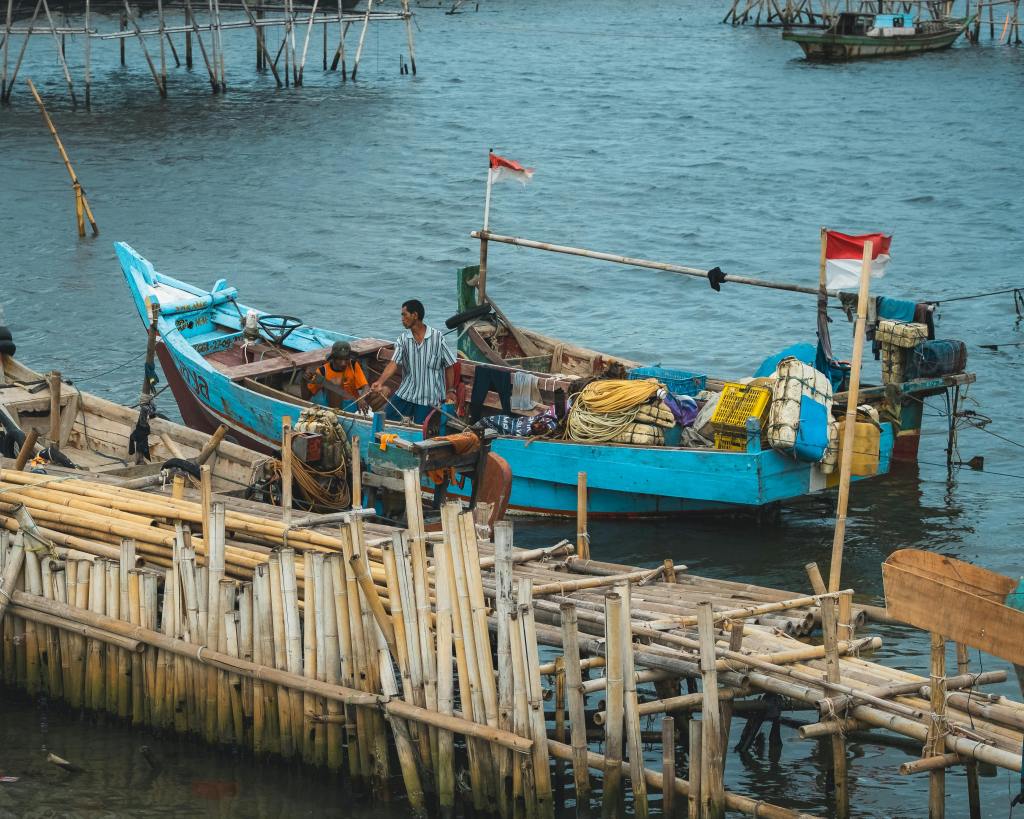
While his uncle teased him saying little Jacob first had learned to swim before he even walked. Born in a small Indonesian island village with houses on wooden poles erected above water, resembling a small Venice, his people thrived as sea nomads. Their livelihood centered around fishing, and the smoke of the grilled fish filled the air along wooden alleyways.
Now a grown man living in Jakarta, Jacob had fled the dire living conditions in his village as fish catches dwindled and unsettled times loomed again. His childhood aspiration to embrace the far horizon and the promise to his mother nestled deep in his heart. Sweet memories lingered, and for these memories, he kept pieces of equipment meticulously locked up in a bag tossed under his rickety brass bed; the diving suit and the spearfishing gear of his father.
The allure of the underwater world had always fascinated him and served as a sanctuary where all his troubles faded, leaving room for peace of mind. Once again, he felt the longing to immerse himself within deep waters and the vast expanse of the ocean stretching beyond sight.
On his way to the bay later that afternoon, Jacob walked oblivious to Jakarta skyscrapers that used to fascinate him, the touristic marina buildings where docking yachts bobbed to their anchors. He went straight to the beach and sat on its warm sand contemplating over the serene water and the waves gently dissipating in their bubbly foams. He took off his shoes, rolled his trousers to his knees, and padded across the edge of water to reconnect to the biting cold of the sea before his dive the next day.
Early in the morning, Jacob retrieved the bag from under his bed and checked his diving gear—drysuit, gloves, speargun, snorkel, fins, goggles, and his father’s special knife. He scattered them across the cold floor, each piece evoking memories. Gathering his gear, he hefted the bag onto his motorcycle and rode to the sea for a soothing expedition; the only way to clear his mind and diligently mull over the next move for his life.
Why not also eat some real fresh fish as in old times! he thought with a smile.
He rode south of the Jakarta Bay where empty beaches and rocky cliffs stretched in virgin landscapes. Stopping by a gravelly cliff, his heart raced and his hands quivered as a lover at the sight of the long-lost beloved healer.
The sun ascended, casting a soft golden glow down the rocky beach. Crisp and invigorating air carried an unmistakable scent of salt and sea. Gentle waves kissed the cliffside, creating a soothing touch that clung to his heartbeats. Seagulls soared up the sky, their calls blending with the ocean’s distant murmur. The bracing air promised a refreshing day.
His face flushed with excitement.
Strapping on his hefty backpack, Jacob made his way through the narrow cliff ridge down to the rocks. He landed next to a cleft where the unruffled water syphoned through the rocks and pebbles, splashing against the cliffside before gently towing back. He put on his gear, tossed his bag into a narrow crevice in the cliff, and with his spear like a supplement to his own body, he glided effortlessly through the chilly water.
Now, he felt himself again.
For the first half an hour, he glided over the water; a moment to reclaim his lost soul to where it belonged. The sunlight cast its golden rays, creating shimmering reflections on the gentle ripples below. Then, he arched gracefully and drifted down deeper. The water embraced him as if he had been an old acquaintance and aside from the bubbles trailing behind him, the sounds of the surface world faded away.
Jacob inherited the long breath-holding from his ancestors, rivalling even dolphins.
Being away from diving for quite a while, he grappled with a tight breath grip. Promptly, he made his first ascent to gasp for air, refuel his lungs, and then dived again. This time, arming his speargun and scanning the shadows behind tangled seaweed wefts and the intricate reefs.
He was ready for a fish catch.
He navigated through schools of colourful sea creatures and picturesque landscapes, and with locked eyes, his focus narrowed on a solitary fish; its scales reflected the play of flickering light. Poised and steady, he aimed at the fish, his hands hovered over the trigger and a muted thud echoed the placid water as the spear shot surged forward piercing through the fish flesh and bones. In an instinctive struggle of survival, the medium-sized fish didn’t give in. Instead, it jerked away in a desperate burst of speed, thrashing in a defiant resilience.
The fish darted for cover, disappearing beneath a cluster of rocks, vanishing into the shadows. But Jacob wasn’t ready to let go. He knew this skirmish would be brief. He pushed forward, undulating gracefully through the deep water, determined to retrieve his catch. The fish fought back, twisting and diving deeper into the refuge of sand and reef. As he reached for it, Jacob felt something strange—fingers; human fingers.
Doubt washed over him like a riptide. Was it his imagination? The blur of seaweed or maybe the tentacles of a lurking cephalopod? He hesitated, peering into the rocky crevice. And there it was; a pale hand, emerging from the sand, fingers swaying gently with the current, like the hand of a worshipper in supplication. He blinked, heart pounding, unsure if it was real. But when he reached out and touched the fingers, they were cold. Motionless. He could feel the ridges of the fingernails.
No, these are human fingers. He freaked out as if struck by an electric current.
Blood rushed to his brain and he felt an urgent need to gasp for air. With frantic strokes, he shot to the surface, fins kicking hard. His heart throbbed with growing tension. He snatched his snorkel and goggles off his face and let out a relieved sigh almost as noisy as his forceful flashing out of the water. He took a deep breath and glided back to the rocky cleft, discarding the fish, too overwhelmed to care. He plopped down on the shore assorted pebbles, the body shivering.
Frozen in disbelief, his shivering grew further intractable. It was his first time to be right in front of a dead body.
He patted his face and chest as if he were trying to seek tangible evidence that hopefully it was a mere dream.
But no, it was real.
he staggered to the nearest rock and perched on a rock as he looked sideways, unreasonably inspecting whether anyone knew about the scary and unsettling discovery. Restless, he went up the cliff where his bag had been tossed and laid over the warm gritty sand. He closed his eyes for a brief moment trying to loosen up his tense body and fathom out the whole eerie incident.
Then, questions clawed at him.
Should I go and inform the police?
What if they suspected me to be the killer?
What could’ve happened to this dead person?
A flash of memory hit him—long, dark hair swaying beneath the water where he’d seen the lifeless hand. It must’ve been a woman, he thought, though he wasn’t sure.
Suddenly, he leapt to his feet, panic gripping him again. “The speargun, where is it?”. With frantically scanning looks here and down the rocky beach, the speargun was nowhere to be found. He lost not only the fish but also his father’s prized possession that must have been dragged down by the lead weight to the seabed. Yet there, still floating on the water, was the buoy tethered to the gun by a line.
He laid down once again, face to the sky, trying to collect his thoughts, ease his mind and regain his composure.
After a stretch, he made his way down the craggy slope, waded through the water slipping on his snorkel and goggles and then glided towards the buoy. He clutched the line and sliced his way down the water. The line felt taut—a good sign. The gun was still attached. He thought about pulling it up but that might cut it off and then lose track of the speargun as the current would drag it away.
He followed the line giving it gentle touches, and flashes of vivid images of the corpse fingers came unbidden to his mind. That distracted his attention for a while, but nothing would stop him from retrieving the speargun. It wasn’t just a tool—it was his father’s legacy.
He gave his fins stronger strokes this time and, there, the speargun came into view, nestled on the sand. Relief flooded him as he reached out, gripping it like a prize. But as he turned to ascend, something strange caught his eye—a faint glow from a crevice in the rocks. Curious, he swam closer. A camera lay there, half-buried in the sand. He plucked it up, giving it a quick glance before kicking towards the surface.
Yet, the horrific image became embedded in his brain.
That night, he abruptly woke up as it clung to his mind, his body drenched in cold sweat. The haunting scene replayed itself in his dreams, refusing to loosen its grapple. He turned the light on and looked around his room. Over the tiny bedside table laid the small camera he had found among the seaweed and sand. Wiping his clammy face, he gingerly laid hand on it and picked it up, the casing still slick with grey-green algae.
He pulled at the latch, prying open the waterproof housing. The camera, small but intact, gleamed under the dim light. He took the camera out, spun it, and twirled it closer to his eyes. It looked clean. His fingers trembled as he pressed the power button. The screen flickered to life.
Jacob scrolled through the footage.
“Oh, my God,” he whispered. The images showed a young girl, vibrant and alive, her face beaming in photos and videos—laughing with friends, hugging her family.
Then, his breath froze up. His heart slammed in his chest.
There she was, embracing his ex-company manager, the spark of romance unmistakable in their eyes.
Days later, the news of the woeful event went viral on social media as the local press headlined his serendipitous discovery as “the Indonesian human dolphin who unveiled one of the most brutal murders ever witnessed in recent history”. Jacob had promptly reported the shocking incident to the police and shared the camera footage with the press. It didn’t take long for the manager to crumble under the weight of conclusive, irrefutable evidence of his gruesome crime.
His father’s wise saying etched in his memory, gained tangible significance as Jacob exposed the heart breaking tragedy of the young girl.
“Remember my son, standing up against darkness requires navigating through the shadows, even if it means risking everything”. A saying that endowed him with determination to expose the ruthless criminal who, further to this, had deprived him from seeing his bedridden father.
Following that incident, Jacob became the talk of the town and his news spread like wildfire within his former company. But it took him a while before he fell back into the usual pattern of his life after a whirlwind of press contacts and media frenzy recounting the shocking events.
Yet, on a beautiful morning and as he sat at ease sipping his coffee, his phone rang, displaying an unfamiliar number on the screen. Hesitant, he answered and a voice greeted him, warmly.
“Hello, is this Jacob?” the caller asked.
“Yes… May I know who’s calling?” Jacob inquired; curiosity tinged with caution.
“I’m the boss of the company you used to work for.” The voice continued gently.
“Oh, yeah” Jacob’s heart skipped a bit and then mumbled “Welcome boss”
“Look Jacob” The boss intoned, his voice earnest “I want you to come to my office, now. I need to talk to you, hero”
“Yeah, I’ll be right there” Jacob responded, uncertain of the news awaiting him from a boss he had barely seen and never talked to, but the use of the word “hero” acted as a balm to his worries, offering a sense of ease and comfort.
Nevertheless, a sudden wave of confusion swelled within him. Overwhelmed by the call of his ex-boss, Jacob found himself standing in front of his tilting wardrobe, hesitant about what to wear for the unusual meeting. Worn Shirts and T-shirts, shabby jeans of different colours and brands littered the bedroom floor as he sifted through his options. In the midst of this bewilderment, his jittery hands caused him to drop the accessories he picked out. The blunt shaver and the unpolished shoes gave him weary moments. Finally, he mounted his clattering motorbike, heading towards the company.
Upon arriving at the firm’s premises, Jacob stepped inside to find two rows of employees applauding his arrival. His boss stood at the front, pride evident in his expression, welcoming him into the office.
The workers chattered in amazement before resuming their duties, while the boss humbly closed the office door.
“Jacob” The boss pronounced
“Please, have a seat,” he said, gesturing to the chair.
The boss lounged on his chair in a composed fashion, then bobbed to the front and put his wrists on the desk, looking at Jacob through his thick lenses.
“First, I’d like to acknowledge your bravery in unveiling the heinous crime committed by our former manager, and anyway he got what he deserved. Second, I just came to learn about the reasons why you resigned, and I must admit that you did the right thing because, as it looks, you have always been an honest young man. I understand your feelings, and I offer my sincere condolences for the loss of your father.”
“Thank you, boss” Jacob replied, shifting uncomfortably in the luxurious chair
“Tell me, where did you learn to dive?” The boss asked, casting a smile.
“I’m from Bajaus. We always lived in stilt houses, surrounded by water. I learned diving before I could even walk” Jacob stammered, still adjusting to the unusual chair.
“That’s encouraging” the boss nodded, bobbing back and slightly rocking in his seat.
“Look, Jacob. For all the brave man you are, and because of your sailing skills…” The boss said and stood silent for a moment, hunched to the front, looking straight at Jacob’s eyes, then he resumed his talk. “…and for the wide knowledge and experience that you have acquired as a quality controller working in our company, I appoint you as our accredited overseas quality control manager. You will work with our contracted foreign fishing vessels and companies, mostly offshore and in different places around the world. I hope you accept this job offer”
Left in a state of shriek elation as he went back to his modest studio apartment, Jacob shouted in exuberant screams, shedding warm tears of joy.
Yes, finally I made it…. Yes, mum I made it…. I made it mummy!!
Brahim Laaraibi is an aspiring writer based in Dakhla, Morocco. With a passion for literary fiction, Brahim has been honing his craft for years. His work explores themes of social and human connection, aiming to create compelling and imaginative stories that resonate with readers. Brahim holds a university degree in English literature and regularly participates in local writing workshops and literary events.
 BLFiction
Leave a comment